Don’t Sell Your Passions. Buy Them.
Following your passion sounds inspiring. But talent and market demand are better…
A huge myth among entrepreneurs is that you should follow your passion.
You’ve heard it a million times. It sounds inspiring. It sounds modern. It sounds like wisdom.
It’s also a terrible way to pick a business.
Talent is the better data point.
Everyone has natural strengths. THAT is what matters. And even then, a lot of the time, what people call “passion” is really just positive emotion around something they’re already good at.
But the truth is simple:
You need to chase the money, not what you love.
That doesn’t mean become a soulless mercenary. It means stop using emotion as your main business filter.
Business is competitive. Not “kinda competitive.” Brutally competitive.
If you pick a game that doesn’t match your strengths, you are voluntarily choosing to fight uphill against people who are simply better built for that game than you are.
That’s obvious in sport. If you want to make the NBA without the physical profile for it, hard work alone is probably not saving you.
The same logic applies in business. Some people are naturally better at sales. Some at operations. Some at persuasion, leadership, writing, numbers, design, product instinct, aesthetics, relationship-building, or seeing what the market actually wants.
If your strengths don’t match the game, you chose the wrong battlefield.
A lot of “product-market fit” is really just founder-market fit in disguise.
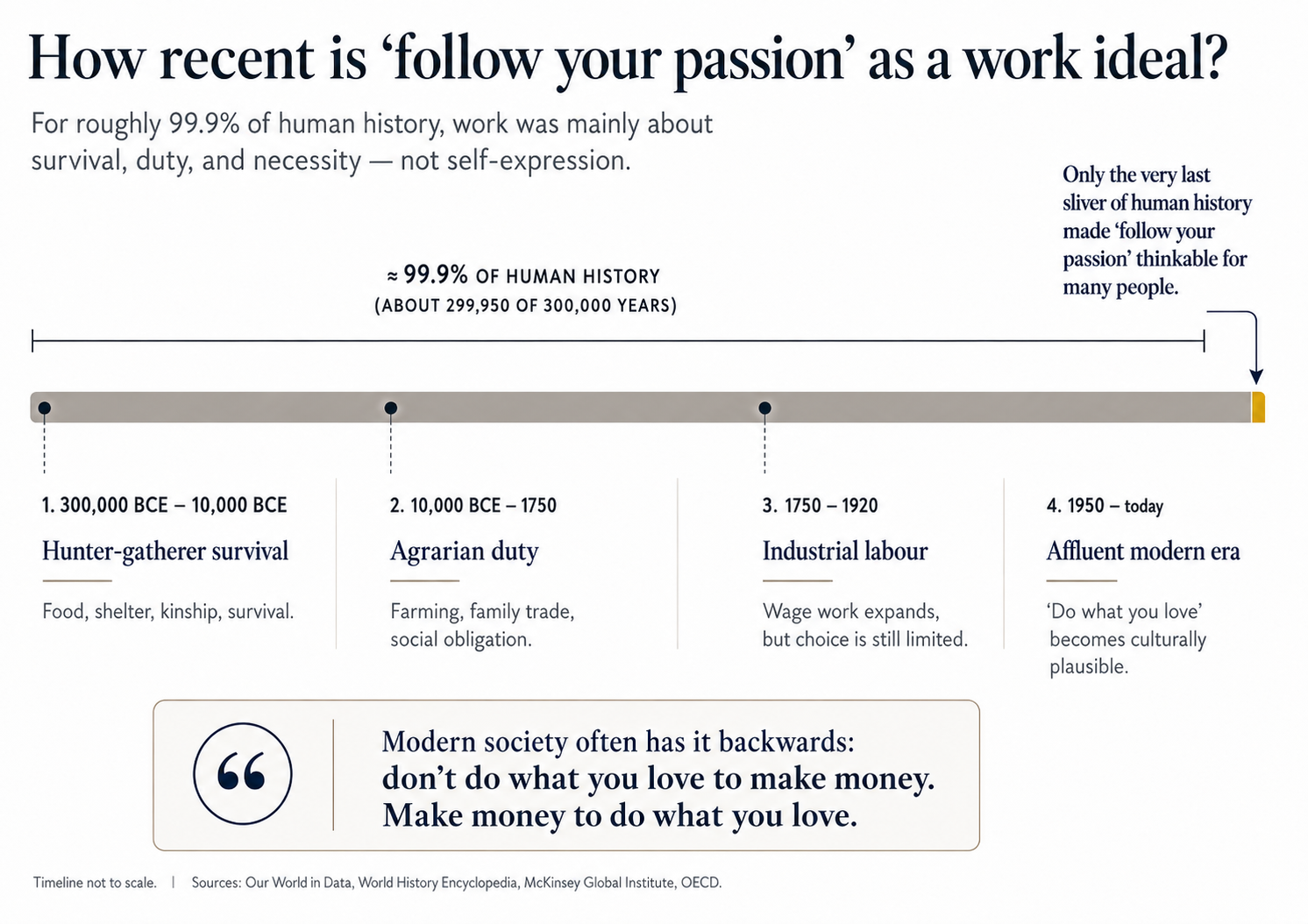
For 99.9% of human history, people did not get to do what they loved.
They did what duty demanded. What survival demanded. What family demanded. What circumstance demanded.
So let’s be honest: the ability to “follow your passion” is a modern luxury.
And what is a luxury? Something you afford with excess.
Which means modern society has this completely backwards.
Don’t do what you love TO make money.
Make money TO do what you love.
Doing what you love usually comes after success, not before.
Don’t sell your passions. Buy them.
That is the cleaner order.
If making money is hard, then keep spending money easy. Let your passions be where your money goes — not necessarily where your income comes from.
Your passions are fantastic places to spend your time. Leisure. Fun. Relief. Beauty. Interest. Great. But that does not automatically make them the correct commercial vehicle.
Yes, there are exceptions. Some people are talented enough, lucky enough, or well-positioned enough to build directly from what they love.
Most people are not.

I’m not saying you should hate your work.
I’m saying passion is not the right variable by which to make business decisions.
You may end up enjoying your work. In fact, you probably will if you become good at it and the market rewards you for it. But that is completely different from using passion as the compass before you start.
Passion is emotional. Business selection should be strategic.
The better question is not:
What do I love most?
It is:
What am I unusually suited for, and where is there money attached to it?
That is a far better place to begin.
Because if you start with passion, what usually happens is this: you romanticise the niche, emotions cloud your judgment, and then you rationalise the choice afterwards.
That isn’t strategy. That’s self-soothing.
This is where people get confused.
You do not need to stay in one niche forever to extract business success from it.
You are not marrying the niche.
You are extracting value from it.
If you pick one of your genuine strengths, go hard for a few years, and build something real, you may end up with a thriving cashflow business or even a sellable asset.
And if later you get sick of the niche? Fine. Automate it. Exit it. Sell it.
That is the beauty of building assets.
A few years in the right game can buy back the rest of your life.
That is a trade most people should take.
This is the part people miss.
Once something starts working, most people begin to like it a lot more.
If the money starts printing, if the market responds, if your competence grows, your relationship to the work changes. Suddenly, the niche doesn’t seem so bad. Suddenly, selling paper doesn’t seem so bad either.
Why?
Because your brain starts rewarding the activity. Competence feels good. Progress feels good. Recognition feels good. And yes — money feels good too.
So no, passion is not always the cause of success.
A lot of the time, passion is the byproduct of success.
That is a very different thing.
Let’s say you love painting and decide to turn it into a business.
Now you don’t paint when you feel inspired. You paint when the business needs inventory. You paint when revenue is down. You paint when customers are waiting. You paint when you’re tired.
Then comes the rest of it: admin, tax, refunds, billing, legal headaches, delayed payments, bad customers, debt, inconsistent demand, platform risk, uncertainty.
On and on it goes.
You are no longer protecting the thing you loved. You are forcing it to carry commercial pressure.
That changes your relationship to it.
This is what people don’t think through when they say “just monetise your passion.” Sounds cute. Until the thing you once loved is now attached to deadlines, complaints, invoices, and performance pressure.
Business pushes you into mercenary mode. Often, that is exactly what makes business work.
But it is probably not what you want to do to the thing you love most.
A lot of passions are better enjoyed outside the pressure of monetisation.
That way, they stay yours.
If you have a real edge, use it.
Build around your strengths. Let the market reward what you are naturally good at. Use business as a vehicle to create freedom, not as a shrine to your emotions.
Your passions still matter. Just not as the first filter.
They are what you protect.
They are what you fund.
They are what success lets you enjoy more fully.
That is the order.
Not:
“I love this, therefore it should be my business.”
But:
“I’m good at this, the market wants it, I can build from it, and then I can use that success to buy back more of life.”
That is a much saner way to build.
Don’t sell your passions. Buy them.
Following your passion sounds inspiring. But talent and market demand are better…
Most people try to earn their way to freedom. But ownership changes…