
Most intelligent professionals understand the importance of working hard.
They pursue strong educations, enter reputable careers, and develop valuable skills over many years. Many earn respectable incomes and build stable lives.
Yet when you examine their long-term financial trajectory, something interesting appears.
Even highly competent professionals earning $100k–$200k per year often accumulate wealth surprisingly slowly.
This observation isnʼt a criticism of careers.
Careers can be extremely valuable early in life. They provide training, income, networks, and often the financial runway needed to experiment with business ideas.
But careers are frequently misunderstood.
They are not primarily wealth-building systems.
They are income systems.
Income is tied to effort. Ownership is tied to assets.
When someone is paid a salary, they exchange time and expertise for compensation.
When someone builds a business, the equation changes.
The business itself becomes an asset — something that can generate income and accumulate value over time.
Careers generate income. Businesses generate ownership. This difference can be expressed very simply.
For most employees, long-term wealth accumulation roughly follows this equation:
Net Worth ≈ (Salary × Savings Rate × Years Worked)
In other words, wealth grows slowly through incremental savings from income.
Entrepreneurship follows a different structure:
Net Worth ≈ (Business Profit × Savings Rate × Years Operated) + (Business Profit × Market Multiple)
Part of the income may still be saved along the way. But the real driver of wealth becomes the asset itself. Employees primarily build savings.
Entrepreneurs build assets.
This distinction explains why ownership plays such a large role in wealth creation.
Even for the average person, pursuing ownership — rather than relying solely on employment — is often the more rational long-term strategy for building wealth.
Most careers operate within a predictable framework.
You perform well, develop expertise, take on more responsibility, and gradually earn higher compensation.
This system works well for generating stable income.
But it is structurally inefficient for building significant wealth.
Income is constrained by several structural factors:
• organisational hierarchies
• promotion cycles
• personal tax rates
• the number of hours a person can realistically work.
Even in high-paying fields, these constraints remain. Consider a lawyer earning $200,000 per year.
At first glance this appears extremely lucrative.
But if that role requires 80–100 hour work weeks, the math begins to look different.
A $200k salary across a 90-hour average work week works out to roughly: $42 per hour before tax.
After Australian income taxes and Medicare levy, the effective hourly income can fall closer to $25–$30 per hour.
At that point, the hourly earnings begin to resemble what many entry-level or service workers earn — cleaners, janitors, retail staff, or hospitality workers.
The difference is that those roles rarely require a decade of education, professional accreditation, and 90-hour work weeks.
Prestige does not change the underlying economics.
A $200k title does not magically create more hours in the week.
The professional may be intelligent and disciplined.
But their income remains fundamentally constrained because it scales primarily with time worked.
And the tradeoffs extend beyond money.
Many professionals also spend decades:
• answering to a boss
• navigating corporate politics
• operating with limited autonomy
• performing work that may or may not feel meaningful
There is also a deeper structural reason salaries remain capped.
If an employee generates $200,000 in revenue for a company, the employer cannot pay them $200,000.
If they did, the company would make zero profit.
Instead, the company is incentivised to maximise profit from that employeeʼs output.
Which means:
Profit = $200k − employee salary
The smaller the salary, the larger the profit.
From the companyʼs perspective, the optimal strategy is therefore simple:
• identify productive employees
• pay them less than the value they generate
• extract as much output as possible
This is not malicious.
It is simply how businesses function.
But it also explains why employees eventually encounter income ceilings. In many careers, hard work is rewarded with more hard work.
To illustrate the difference, consider two simplified five-year scenarios.
Both individuals earn roughly the same total income over five years. One is a professional earning a stable salary.
The other is building a business where income fluctuates — sometimes higher, sometimes lower.
But the business owner is also building an asset.
Over five years, both individuals earn roughly similar income.
But at the end of year five something important happens.
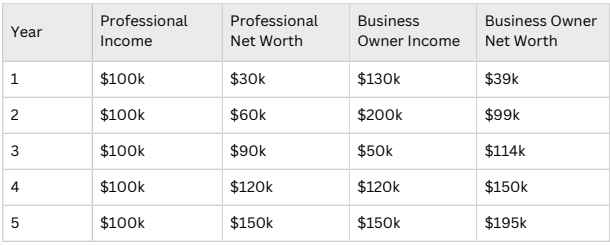
The professional continues earning a salary.
The business owner now owns a business generating $150,000 per year in profit.
If that business sells at a modest 5× multiple, the owner receives roughly $750,000 from the sale.
Their total wealth becomes approximately $795,000, compared with the professionalʼs $150,000.
$795,000 is already roughly 80% of the way to becoming a millionaire. For many people, this level of capital is already life-changing.
Invested sensibly, it can generate passive income and dramatically accelerate financial independence.
By contrast, the professional earning $100k per year will likely still need to work for decades to accumulate the same level of capital through savings alone.
And remember — this example assumes the professional saves 30% of their income, which is already extremely aggressive compared with what most households manage in practice.
Contrary to popular belief, the numbers suggest something surprising. Entrepreneurship may feel riskier emotionally.
But mathematically, ownership is often the more rational strategy for building meaningful wealth.
You canʼt sell a career. You can sell a business.

A useful way to think about entrepreneurship is through a simple metaphor. Imagine spending five years building a house.
Each day you show up, lay bricks, install plumbing, and slowly construct something valuable.
Now imagine two scenarios.
In the first, you build the house for someone else.
When itʼs finished, they own it.
You were simply paid wages for the labour.
In the second scenario, you are building a house you will eventually own. When the house is finished, you can live in it, rent it out, or sell it.
That house becomes part of your net worth.
This is essentially what happens when someone builds a business.
The work may be just as hard — sometimes harder.
But at the end of the process, something tangible remains.
An asset.
Another important distinction is that asset values are not limited by savings rates.
A business valued at $750,000 does not require saving $750,000 from income.
Its value is determined by profit, demand, and market conditions.
In other words, the value of the asset can grow far beyond the amount of cash that was ever personally saved.
There is also a practical detail many Australians overlook.
While Australian labour laws strongly protect employees — which is generally a positive thing — the tax system also contains significant incentives for small business owners.
These include:
• small business CGT concessions
• business expense deductions
• asset write-offs
• company tax structures
In practice, these incentives can make building and selling a small business one of the most financially efficient paths to wealth available within the Australian system.
Many entrepreneurs discover this almost accidentally.
They start a business simply trying to make money — and later realise the broader financial advantages that ownership provides.
For this reason, I personally believe that building and selling small businesses is one of the most realistic paths to wealth for the average Australian.
This is why ownership can feel counterintuitive. A steady paycheck feels like progress.
Saving money feels responsible.
By contrast, entrepreneurship often feels chaotic.
Income fluctuates. Ideas fail.
Savings get reinvested.
To many people, this feels like moving backwards.
Yet if the goal is to build meaningful wealth, ownership remains one of the most powerful mechanisms available.